
What It Means to Be a Channel, Not a Healer
September 2026 · 4 min read · By Vanessa Chugani
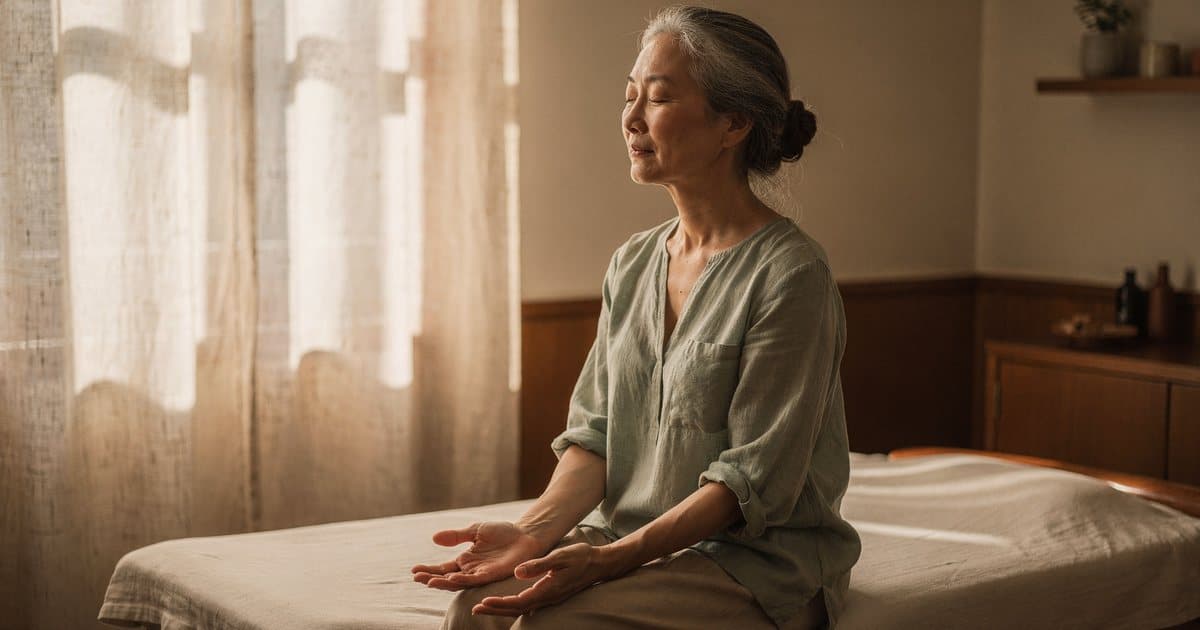
People sometimes thank me for healing them, as though I reached into their body and fixed something while they lay there with their eyes closed. I understand why it sounds that way. It still is not what happened, and I would rather say so plainly than let a kind sentence stand uncorrected.
The assumption I keep meeting
Most of what we know about being helped comes from doctors, physiotherapists, dentists. A professional looks at a problem, decides what to do about it, and does it to you. You lie still and they act. It is a reasonable model to bring into a Reiki room, because it is the only model most people have for lying down while someone else works nearby.
New clients often ask me, before we start, what I am going to do to them, the same way they might ask a masseuse which muscles I plan to work on. It is a fair question. It is just not one I can answer the way they expect.
I am not deciding what your body needs and sending something toward it. I do not know what needs attention in you better than your own nervous system does. In all the years I have done this, I have never once looked at someone on the table and thought: I know what to fix here.
What a channel means, plainly
I place my hands somewhere. I keep them still. I move them to another place. That is the whole of what I do with my hands. Whatever happens after that belongs to the person lying there, not to me. I did not generate it, direct it or aim it anywhere. I am the one holding still while it happens, which is a smaller job than people expect, and I like it that way.
This is also why a distance session makes sense to me, in a way it would not if I believed the healing came from me. If I were the source, being in the room ought to matter enormously, and it does not seem to make the difference people assume. I sit somewhere quiet, hold the same attention I would with someone on the table in front of me, and step back in exactly the same way. The distance is not a compromise. It confirms what I already believed about my own part in this.
I will not tell you what moves through my hands, because I do not know, and I am wary of anyone who claims they do with certainty. Training with me starts from that honesty rather than around it. It is the first thing new students have to unlearn: the urge to push, or to try harder than the moment needs.
Where this matters most
Most of the people who come to me are not injured. They are exhausted, wound tight, running on a kind of alertness they cannot switch off. Think of a jaw that has not unclenched in weeks, or a body that cannot settle even at three in the morning. None of that responds well to being fixed at. It responds to being given room to stop defending itself, which is a different thing, and slower.
Being a channel rather than a healer suits this kind of work precisely because nobody can force a nervous system to stand down. I tried, in my early years, to hurry it along, and it does not work that way. It settles when someone stops doing anything to you and simply stays present while your own system remembers how to lower its guard. If any of that sounds familiar, this is usually when people start considering it, not because something is wrong, but because they are tired in a way that rest has stopped touching.
What I am actually watching for
Not a signal from my hands. A breath that gets longer, or shoulders that drop half an inch and stay there. That is the body doing its own work, in its own order, while I sit quietly nearby instead of steering it.
Some people feel warmth or heaviness under my hands during a session. Others feel nothing at all, and worry they are doing it wrong. Neither tells us whether anything worthwhile happened.
It is the first real lesson I give at Level One, before any hand position: sit down, keep your hands still, and let the person in front of you do the work their body already knows how to do.