
What Canggu Taught Me About Holding Space
September 2026 · 4 min read · By Vanessa Chugani
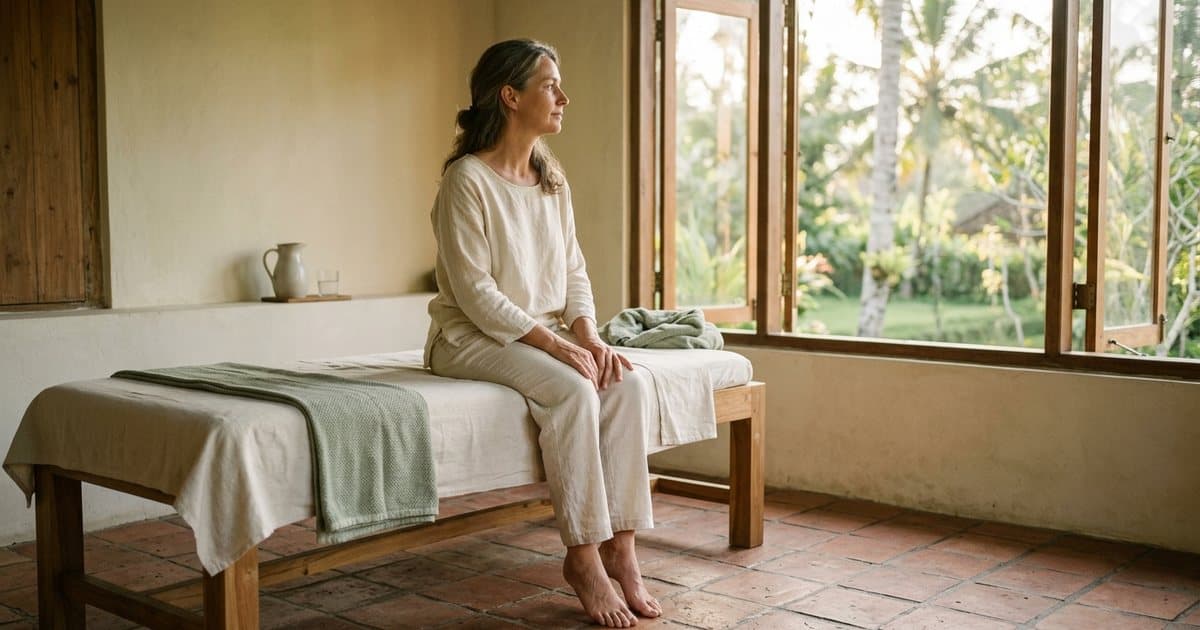
Almost nobody who comes through my treatment room in Canggu is staying still. They are arriving, leaving, six weeks into a decision they have not told their family about yet, or three months out from a marriage that ended somewhere else. Years of treating and teaching people in this state changed how I hold a room. Not because the island has some pull of its own, but because of who keeps walking through the door.
Nobody Arrives With The Full Story
Most of my clients in Canggu have been in the country a matter of weeks. Some are here for good. Most are not sure yet. They do not have their usual doctor, their regular yoga teacher, or a friend who has known them for a decade and can fill me in before we start. I get a person mid sentence, without the paragraph that came before it.
That used to worry me. Early on I wanted the whole story: what brought her here, what she left behind, what she was avoiding at home. I have learned since that I do not need it. Someone can lie on the table with a history I will never hear in full, and the hour still does its work. The shoulders come down from her ears. The breathing slows. Whatever she walked in carrying gets a little lighter for a while. What people usually tell me afterwards is not that they understood something new. It is that they slept that night for the first time in weeks.
The reasons people come are rarely exotic. Jet lag that has not lifted after three weeks. A decision that keeps her awake at two in the morning. A body that will not settle even on a beach. The signs that usually bring someone in read the same here as anywhere else, they just show up faster and closer together.
Holding A Room Without A Container
A treatment room in a town like this does not have the usual context around it either. No spouse in the waiting area, no GP down the road, often no shared first language beyond simple English. I had to build a different kind of steadiness: less about knowing someone's history and more about staying reliably calm regardless of what walks in. I ask fewer questions than I used to. I watch more: the shoulders, the breath, whether she is still translating in her head before she answers me. A person unravelling after a bad year needs the room to hold steady even when she cannot. That is a skill, and Canggu gave me a great deal of practice at it, because so many people land here at the exact point where things are coming apart before they get put back together. If a session sounds like what you need, a private session sets out what that hour actually involves.
It Is Not The Place, It Is The Density
I do not think Canggu itself carries any special charge, and I would rather say that plainly than let a reader assume otherwise. Every town has people going through something. Canggu just has more of them per square kilometre, arriving and leaving faster, further from home than usual. What changed me was not the island. It was the repetition: years of sessions with people who had nothing familiar to lean on except the hour in front of them. That is a skill I carry now, not something tied to this stretch of coastline. If I moved my practice tomorrow, it would come with me.
Teaching The Same Thing
I see the same pattern in the people who train with me. Most arrive at Level 1 partway through a bigger change: a career they are stepping back from, a life they are rebuilding after a divorce or a loss, a second act they are not fully sure about yet. Many are women in their fifties who spent decades in one career and are quietly building a second one behind it, here or somewhere else entirely. Teaching them Usui Shiki Ryoho means holding the same kind of room I learned to hold for clients, except now it runs over weeks instead of an hour. The training page has the levels and how it is structured, if that is the direction you are weighing.
Most students leave the first level still unsure what they will do with what they have learned. That uncertainty is ordinary, and it usually settles by the time they reach Level 2.