
The Pause Is the Whole Point
September 2026 · 4 min read · By Vanessa Chugani
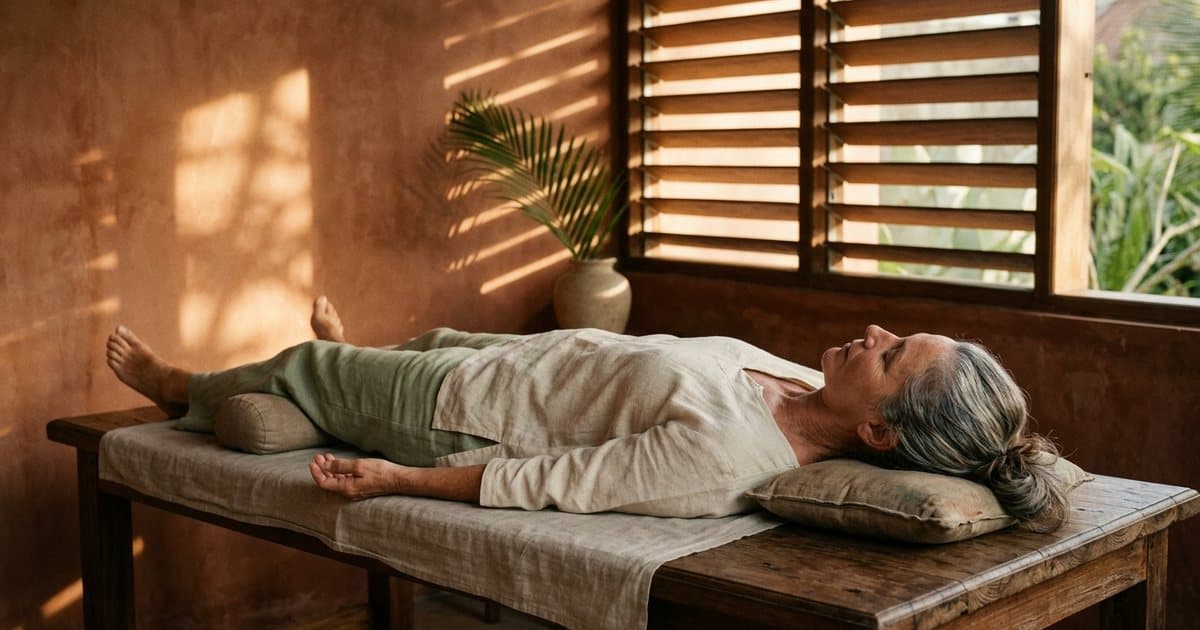
People often ask me what actually happens in a session, as though there is a mechanism I am withholding. There is not one I claim. What I can tell you is plainer than that: for an hour, nothing is asked of you, and that turns out to matter more than any explanation I could offer.
The instruction is to stop
Most of the people who come to see me are not resting anywhere else in their week. They eat at their desks and fall asleep with their phones lit up beside them. They wake at 2am with a list running and no way to put it down. By the time they arrive, stopping is the strange part, not the treatment.
So the first thing a session gives is permission. Nobody needs anything from you for an hour: not a decision or a reply, not a version of yourself that is coping well. That is rarer than it sounds, and for a lot of people it takes the first fifteen minutes just to believe it is real.
The hour itself is the container. It is not the whole of what happens in it.
What people tell me afterwards
What people report is wider than feeling rested. Sleep that finally comes properly. Pain that sits further away than it did. Appetite returning after weeks of picking at food. The tiredness that had become background noise finally lifts. A steadiness in themselves that was not there when they walked in, and the sense of being less alone with whatever they were carrying.
A 2019 study in the Journal of Alternative and Complementary Medicine looked at 1,411 sessions across 99 practitioners and found participants reporting improvements along exactly these lines: pain, tiredness, drowsiness, appetite, breathlessness, mood, general wellbeing. There was no control group in that study, so it tells you what people reported, not what caused it. I think that distinction matters enough to say plainly rather than let a study do more work than it can.
The tension in your shoulders is part of this
People sometimes assume Reiki is for feelings and massage is for bodies, as if the two are separate. They rarely are. A jaw that will not unclench, shoulders that live somewhere near the ears, a chest that will not open, a stomach that grips before anything has even happened: that is nervous system tension wearing a physical shape, and it is exactly what I work with.
If you have a specific injury or a mechanical problem, a good massage therapist is still the better first call, and I will tell you so. But that is a recommendation about where to start, not a limit on what a session can do for the tension that sits on top of stress, grief or a mind that will not settle. I have written more on where the two overlap and where they do not in Reiki compared with massage.
What I will not tell you, and what I will
I will not tell you Reiki treats or cures anything, and I will not hand you a mechanism I cannot back up: no frequencies, no measured energy field or quantum explanation. It is rest and support, not a diagnosis and not a substitute for medical care. I would rather you arrive with an accurate expectation than a romantic one.
What I will tell you is that the research on stress, low mood, anxiety and quality of life is better than most people expect, and largely silent on disease, which is the honest split. A 2022 review of 14 randomised trials in Frontiers in Psychology rated the evidence high for clinically relevant stress and depression, and moderate to high for clinically relevant anxiety. The effect appeared in people who were genuinely struggling, not in people who were already fine. A 2025 review of 11 trials and 661 participants in Systematic Reviews found a significant improvement in quality of life, and the sessions that did best were an hour or more, run eight or more times.
That last figure is the real argument for coming back rather than once, not because one session does nothing: because the pause seems to compound. Eight sessions of an hour is roughly what I would suggest to anyone starting out, and it is also, I think, a fair description of what actually works: not a hidden mechanism, just stopping, reliably, for long enough that your body starts to believe it is allowed. If you want to see what that looks like in practice, private sessions are the place to start, and when people tend to come is worth a read if you are still deciding whether now is the time.