
I am not a sanctimonious spiritualist
October 2026 · 4 min read · By Vanessa Chugani
I do not need you to believe in energy fields. I do not need you to believe the chakra vocabulary is ancient history, because it is not, and I will not pretend otherwise. I am a Reiki practitioner, not a gatekeeper of anything, and the version of this work that makes sharp, sceptical women roll their eyes and walk straight past my door is not the version I practise.
What I will not say to you
There is a stereotype attached to this work, and most of it is earned: the practitioner who speaks in riddles, the page that assumes you already believe in auras before it has told you a single plain fact, the tone that treats your scepticism as a wall to get past rather than a reasonable position to start from. That version of Reiki is exhausting rather than calming, and it is not the one I practise.
I will not tell you Reiki is a treatment for any medical condition. It is not. I will not explain a mechanism, because there is not a measured one to explain: no quantum entanglement, no frequencies, no field anyone has detected. The chakra system taught in Western Reiki is a twentieth-century synthesis attached to Reiki in the 1980s. I teach it as useful vocabulary in training, and I say so plainly, because pretending otherwise would be the easy sell and the dishonest one.
I would rather someone show up with realistic expectations than romantic ones. That is not me being less spiritual than other practitioners. It is me being honest about what I am offering and what I am not, and feeling nothing dramatic during an attunement or a session is ordinary and worth saying out loud rather than glossing over.
The scepticism is usually correct
If you have read a Reiki page before and felt talked down to, or felt the writer assumed you already believed something you do not, your scepticism was doing its job. The honest research on this is more interesting than the mystical version, and more limited too. A 2022 review in Frontiers in Psychology looked at fourteen randomised placebo-controlled trials and found the evidence high for clinically relevant stress and depression, and moderate to high for clinically relevant anxiety. The effects showed up in people who were genuinely struggling, not in people who were already doing fine. The authors still describe their own findings as inconclusive, which tells you something about how this research gets reported elsewhere.
The US National Center for Complementary and Integrative Health says Reiki has not been shown to cause harm, and in the same breath says it has not been clearly shown to be effective for any health purpose, and that no scientific evidence supports the energy field it is said to work through. Both halves are true at once, and I would rather hand you both than one. A 2025 review in Systematic Reviews looked at eleven randomised trials, 661 participants in total, and found a real improvement in quality of life, strongest where sessions ran an hour or more and there were eight or more of them. That is the honest case for booking more than one session, and it is the only case I will make.
What actually happens
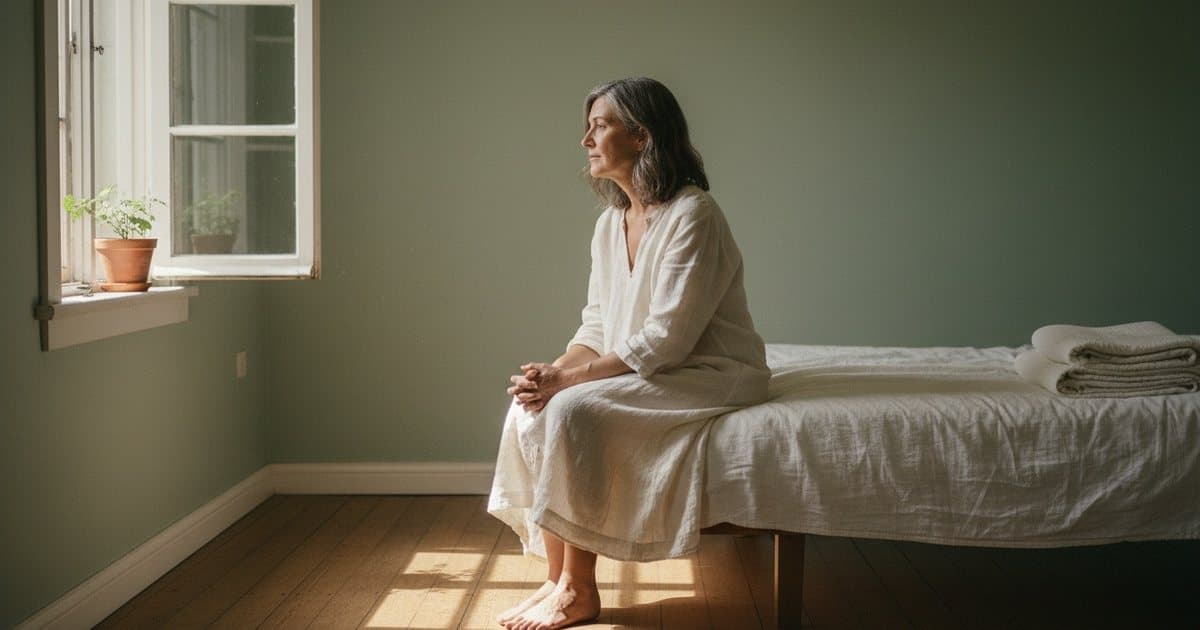
You lie on a table, fully clothed, in a quiet room. I place my hands lightly on or near your body, moving through a sequence. Nothing is asked of you. You do not need to believe anything is happening for the hour to do its work, and you do not need to make conversation or explain why you are there.
What people report afterwards tends to be plainer than the marketing around this work suggests: sleep that comes more easily, a jaw that finally unclenches, a chest that opens, less of the wired feeling at two in the morning, an appetite that comes back. That is a nervous system that has been running hot for a long time, given an hour where nothing is required of it. If what is bothering you is a specific injury or a purely mechanical problem, a massage therapist is still the better first call, and I will tell you that directly rather than let you book the wrong hour. You can read what to expect before a first attunement, or book a private Reiki session directly if that is simpler.
Who this is for
Most of the women I see are not looking for a mystical experience. They are forty to sixty five, often at a turning point: after a career, after children, after a divorce, after a loss. Some are weighing Reiki training as a second act, a proper credential taught level by level with the manual, the attunement and support after it, not a recording and not an automated process, and taught by someone who will tell you plainly what each level does and does not include.
None of them need to believe anything before they start. They need a plain account of what this is and is not, and then the chance to find out what an hour where nothing is required of you can do for a nervous system that has been running hot for a long time.